Architecture Governance Platform
A self-hosted system of record for architecture decisions, with review sized to what's at stake.
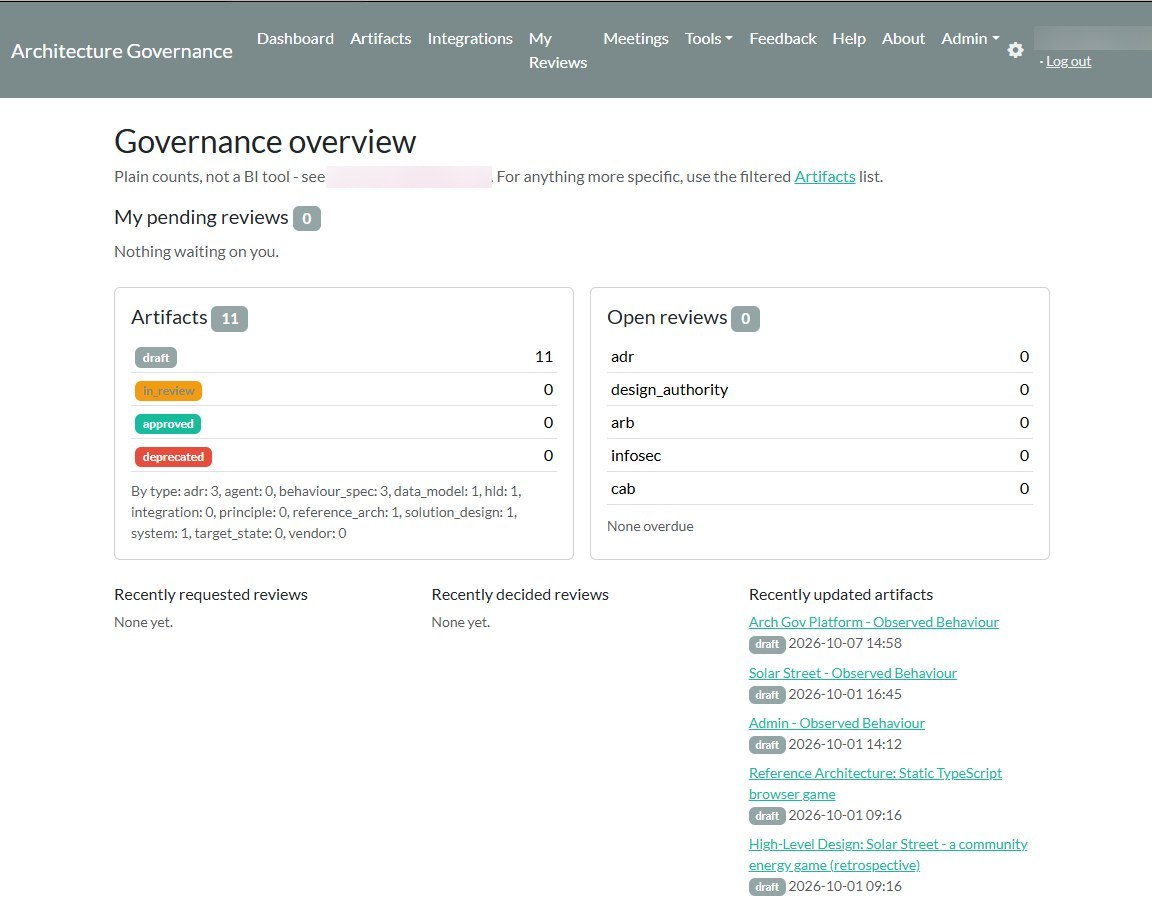
Decisions made in a meeting, a chat thread or someone’s head don’t outlast the person who made them. This platform gives them a home, and a review process that scales with how much a decision matters, rather than putting everything through the same gate.
Routine decisions are logged as an ADR and the team moves on. Decisions that are significant, cross-cutting or set a precedent go in front of a formal review. Deployment risk is a separate concern, so change approval never re-opens the design.
Starter templates cover every artifact type, including variants for web apps, event-driven services, batch pipelines and older monoliths. They give a head start without becoming a straitjacket. Designs cite the principles and decisions they rest on, and those links work in both directions. Whole sets of linked records can be exported as a bundle, readable as PDFs, and imported into another instance.
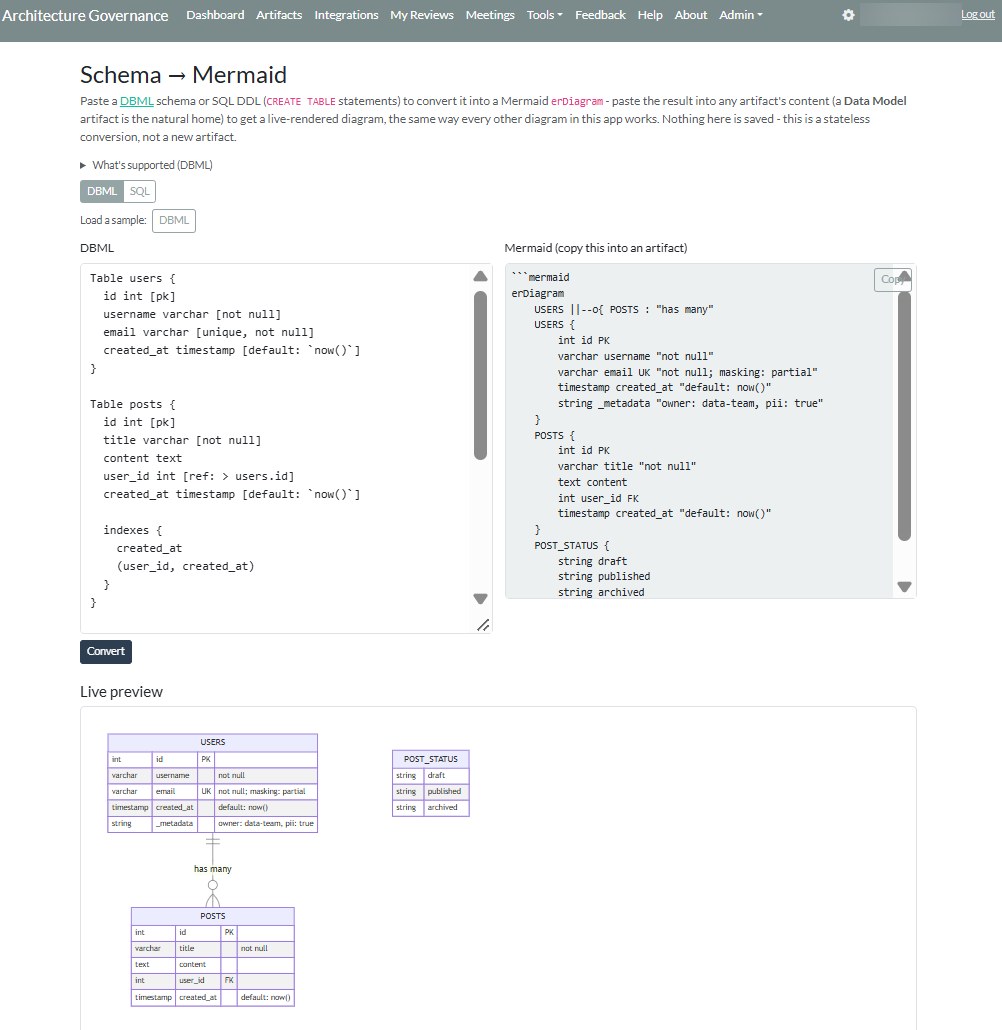
Diagrams are written as text and drawn live on the page, so they change with the design instead of going stale as pasted images. A schema tool turns a database schema into an entity-relationship diagram, ready to drop into a data model.
Discovery: from codebase to catalogue. Most practices already have systems nobody has written down. A discovery skill for Claude Code reads an existing codebase, from a folder or a GitHub repository, and drafts its records for review: the system, its significant integrations, the decisions already written into its code and documents and, for a fuller run, the high-level design, solution design with C4 diagrams, data model and reference architecture. It asks first how deep to go, creates only the records the evidence supports, and links them all to one initiative. A folder holding several projects can be catalogued in one run, with shared services recorded once. The records for Solar Street, elsewhere on this site, were produced this way.
Keeping the details where they belong. Discovery runs in your own Claude Code session, under your organisation’s own account. Your code stays under your control throughout, and the results go only to your own self-hosted instance, as drafts for your team to review.
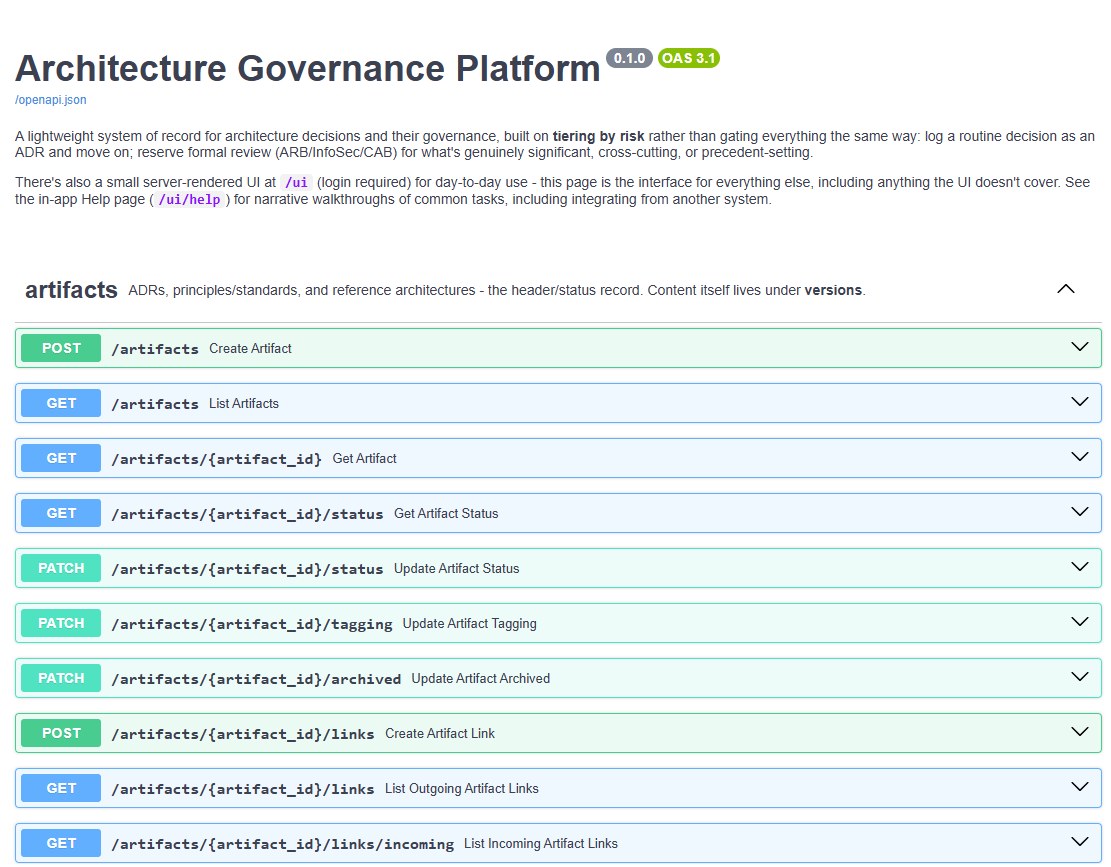
An API for everything. Every record, link, review and initiative can also be reached through a documented JSON API, so the platform can be scripted, fed from other tools or integrated with another system. The discovery skill uses the same API to write its records.